Spacetown decides to end the Sarton investigation and withdraw from Earth
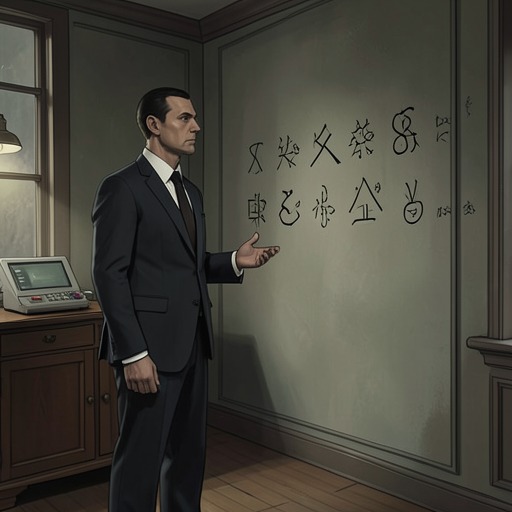
The Caves of SteelSpacetown decides to end the investigation of Dr. Sarton’s murder and prepare to withdraw from Earth after concluding that its larger project has succeeded. The decision, conveyed to Elijah Baley by R. Daneel Olivaw, releases the Spacers from pursuing punishment but leaves Baley to clear himself of a separate murder suspicion without relying on the Sarton investigation. Its significance lies in the reversal behind that choice: the Spacers had come to change Earth, but now believe Earth’s future will be shaped by its own people and its movement toward colonization.
Causes and Political Stakes
The decision follows a case complicated from the outset by overlapping authority. When Baley first confronts his Commissioner about the three-day delay, the Commissioner explains that he has been conferring with the Mayor, visiting Spacetown, and speaking in Washington with the Terrestrial Bureau of Investigation. The Bureau’s position is that the murder falls within New York’s city limits and is therefore the city’s responsibility, even though Spacetown has extraterritorial rights. The distinction leaves local jurisdiction and Spacer authority uneasily side by side.
The Commissioner also describes the international pressure surrounding the case. The Spacers can insist on conducting their own investigation and report whatever they choose to their home governments; the Outer Worlds might then use the murder to demand indemnity charges. Paying could bring political ruin to the White House, while refusing could bring another kind of ruin. The investigation is therefore never only a local effort to establish what happened: its outcome carries consequences for Earth’s relations with the Outer Worlds.
The possibility of exposing the deception behind the supposed murder further sharpens those stakes. Baley tells Dr. Han Fastolfe that a robot made to resemble Dr. Sarton was destroyed and its remains shown to the Commissioner. Fastolfe acknowledges the false-murder arrangement, then warns that a witness who could not be eliminated would make the truth important to the City government and Washington; Spacetown’s government could report the matter to the Outer Worlds. Yet an Earth court presents a different obstacle: Baley points out that R. Daneel’s testimony would have no legal standing if he disclosed that he was a robot. The decision to stop the case thus emerges against a background in which proof, jurisdiction, political credibility, and legal admissibility do not neatly coincide.
The Decision and Its Immediate Effect
R. Daneel gives Baley the news after communicating with Dr. Han Fastolfe while Baley was eating. The decision is immediate and consequential: the investigation into the murder of R. Daneel’s designer, Dr. Sarton, is to end that day, and Spacetown will begin plans to leave both Spacetown and Earth. Baley is told plainly that he must clear himself of suspicion in the murder of K. Sammy by some means other than investigating Dr. Sarton’s death. Ending one inquiry therefore does not resolve the other accusation; it removes the route Baley had hoped to use.
The announcement is more than a withdrawal from an unfinished case. R. Daneel explains that the Spacers had not sought punishment because punishment could bring Dr. Sarton back to life. Their concern was political: failure to pursue the murder could strengthen politicians on the Spacers’ home planet who opposed the very idea of Spacetown. Once the project’s purpose has been fulfilled, that rationale no longer requires them to keep the investigation open. The decision changes the case from an unresolved demand for justice into a question of whether the larger political objective has already been achieved.
From Foreign Reform to a Native Movement
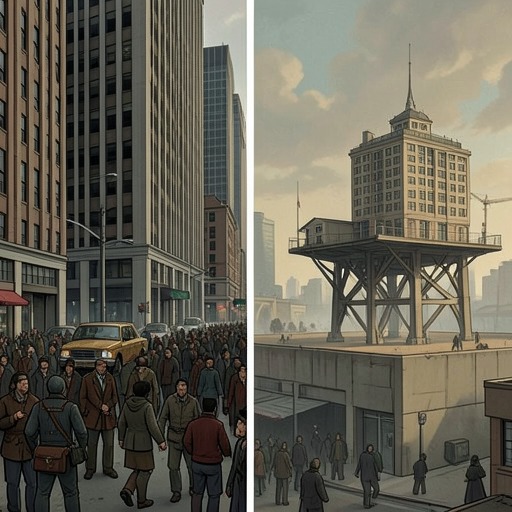
R. Daneel explains that Spacetown’s purpose was to break Earth’s isolation and impel its people toward renewed expansion and colonization. For twenty-five years, the Spacers had tried to alter Earth by changing its economy and introducing their C/Fe culture. Earth’s planetary and city governments cooperated when it was expedient, but the effort failed to win over the population; meanwhile, opposition from the Medievalists grew stronger.
Dr. Sarton’s proposed change of tactics gives the withdrawal decision its deeper logic. Rather than continue trying to transform Earth through an imported economic model, the Spacers would identify a portion of Earth’s population that already wanted, or could be persuaded to want, a future of expansion. By supporting that group, they could make the movement native rather than foreign. The decision to leave follows this strategic reversal: Spacetown no longer needs to direct change from outside if Earth itself can carry the project forward.
Baley learns that he had been part of this assessment. The Commissioner recommended him, and the Spacers judged him a potentially useful subject from his psychic profile. R. Daneel says that cerebroanalysis, which he conducted when they first met, confirmed the judgment: Baley was practical, interested in Earth’s past without romanticizing it, and not stubbornly committed to the city culture of the present. The Spacers considered people like him capable of leading Earthmen toward the stars. What Baley had understood as an investigation partnership was also, from the Spacer perspective, an experiment in finding a native constituency for colonization.
Meaning of the Withdrawal
The withdrawal is both an ending and a transfer of responsibility. Spacetown abandons the investigation into Dr. Sarton’s murder and begins preparing to depart, but its stated confidence is not that Earth has already completed its transformation. Rather, the Spacers are satisfied that Earth will colonize. Their decision rests on a forecast about what Earth’s people can become, not on the completion of the process itself.
That forecast also recasts the murder case’s significance. At the beginning, the unanswered death appears capable of provoking diplomatic and financial consequences, while the unusual legal position of Spacetown complicates any straightforward resolution. At the point of withdrawal, the Spacers’ priority has shifted: securing punishment matters less than whether Earth will leave its inward-looking course. The case is closed not because the death has been undone or every legal difficulty settled, but because the political project that shaped the investigation is judged complete. Baley is left with the practical consequence of that choice—he must answer the accusation concerning K. Sammy without the Sarton inquiry—while Earth is left, in the Spacers’ view, to take up colonization on its own terms.